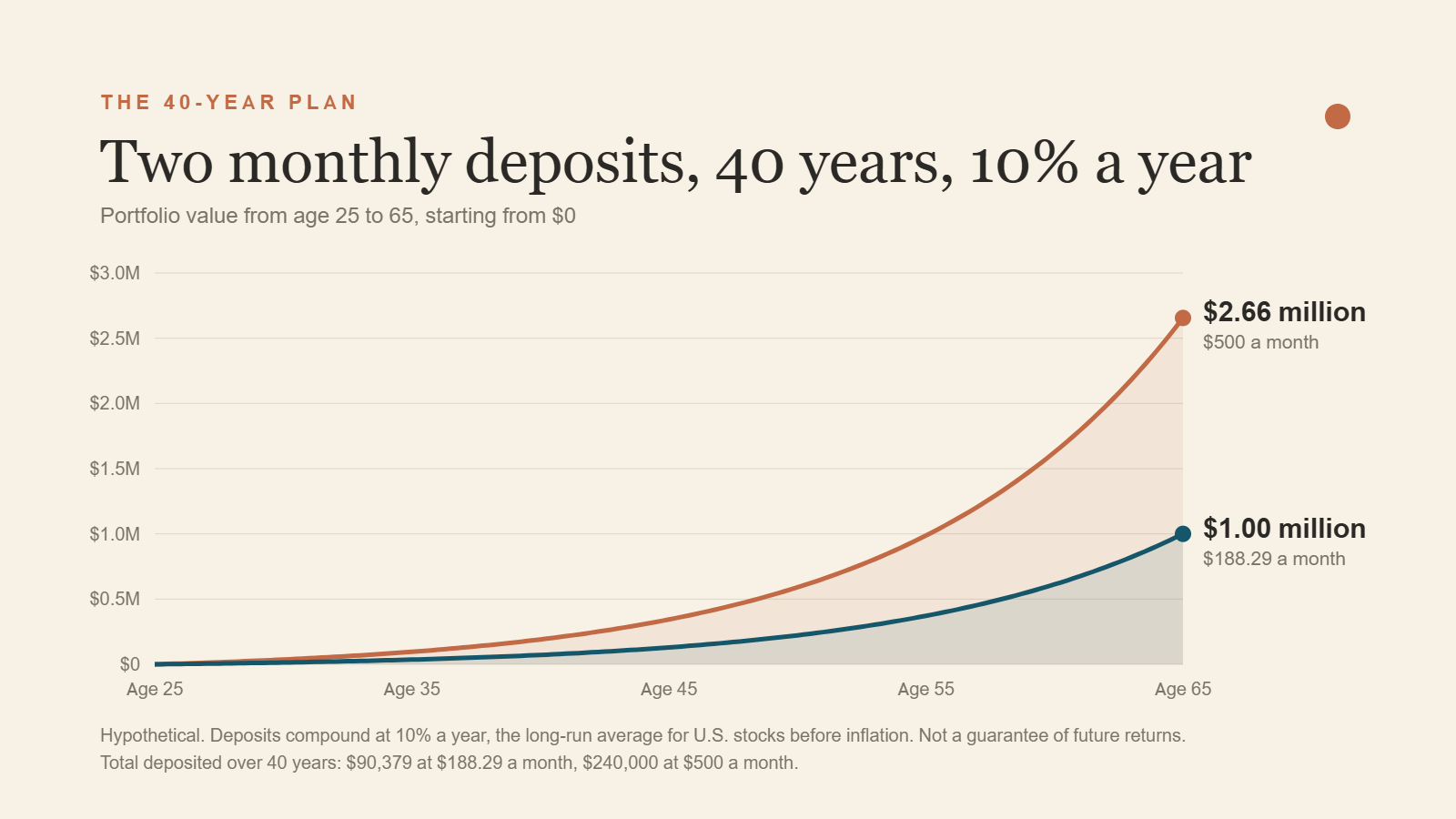
$188.29 a month. That's all it takes to become a millionaire.
Amber is 25 and just paid off the last of her student loans ahead of schedule. She has $0 saved, but now has room in her budget to invest and puts $188.29 into a stock portfolio every month until she turns 65. Assuming her portfolio earns on average 10% per year, she will retire with $1,000,000.
Her deposits over those 40 years add up to $90,379. The other $909,621 is growth. Amber supplies less than a tenth of the money and compound interest supplies the rest.
Where the 10% comes from
The U.S. stock market has returned roughly 10% a year on average over the past century, before inflation. Inflation has run at about 3% a year over that same stretch, so in today's purchasing power the return is closer to 7%. I use 10% here because that's the dollar figure that shows up on Amber's statement. Just keep in mind those are 2066 dollars, and a million of them will buy less than a million buys today.
Some decades were better than 10%, some were far worse, and none of them delivered 10% in a straight line. The average only shows up for the people who stay put through the good and bad years.
A million probably won't be enough
Fair caveat. After 40 years of 3% inflation, $1 million will feel about like $300,000 does today. Comfortable, but not lavish. So let's bump the monthly number.
At $500 a month, the same 40 years, the same 10%, Amber ends up with about $2.66 million. Her deposits total $240,000. Growth does the other $2.4 million. The chart above shows both paths, and the gap between them is almost entirely during the last 15 years.
What $2.7 million pays for
A common rule of thumb for retirement spending is the 4% rule. Withdraw 4% of the portfolio in your first year of retirement, raise that dollar amount with inflation each year after, and historically the money has lasted 30 years or more. Four percent of $2.7 million is about $106,000 a year, before taxes.
Keep in mind that the research behind the 4% rule assumes a balanced portfolio of roughly half stocks and half bonds, and not the all-stock portfolio that got Amber to $2.7 million in the first place. Stocks build the pile. A mix of stocks and bonds is what lets you draw from it steadily without a bad year in the market knocking the plan off course. So in the years leading up to retirement, Amber's allocation should begin to shift more conservative, adding bonds gradually so that a downturn right before or right after retirement doesn't do lasting damage.
The bottom line
Amber never got a windfall, never picked a hot stock, and never earned a huge salary. She put $188.29 a month into a boring portfolio and left it alone for 40 years. If $500 fits the budget, even better. The hardest part is starting, and the second hardest part is not touching it during all of the ups and downs.
And if you're 40 and haven't started yet
Start today! Say Dan is 40, his career just clicked, and he finally has room in his budget to invest. To reach $1 million by 65 at the same 10% average return, he needs about $847 a month. More than Amber, because his money has 15 fewer years to compound. But still very doable for someone whose income just took off, especially if a 401(k) match is available.
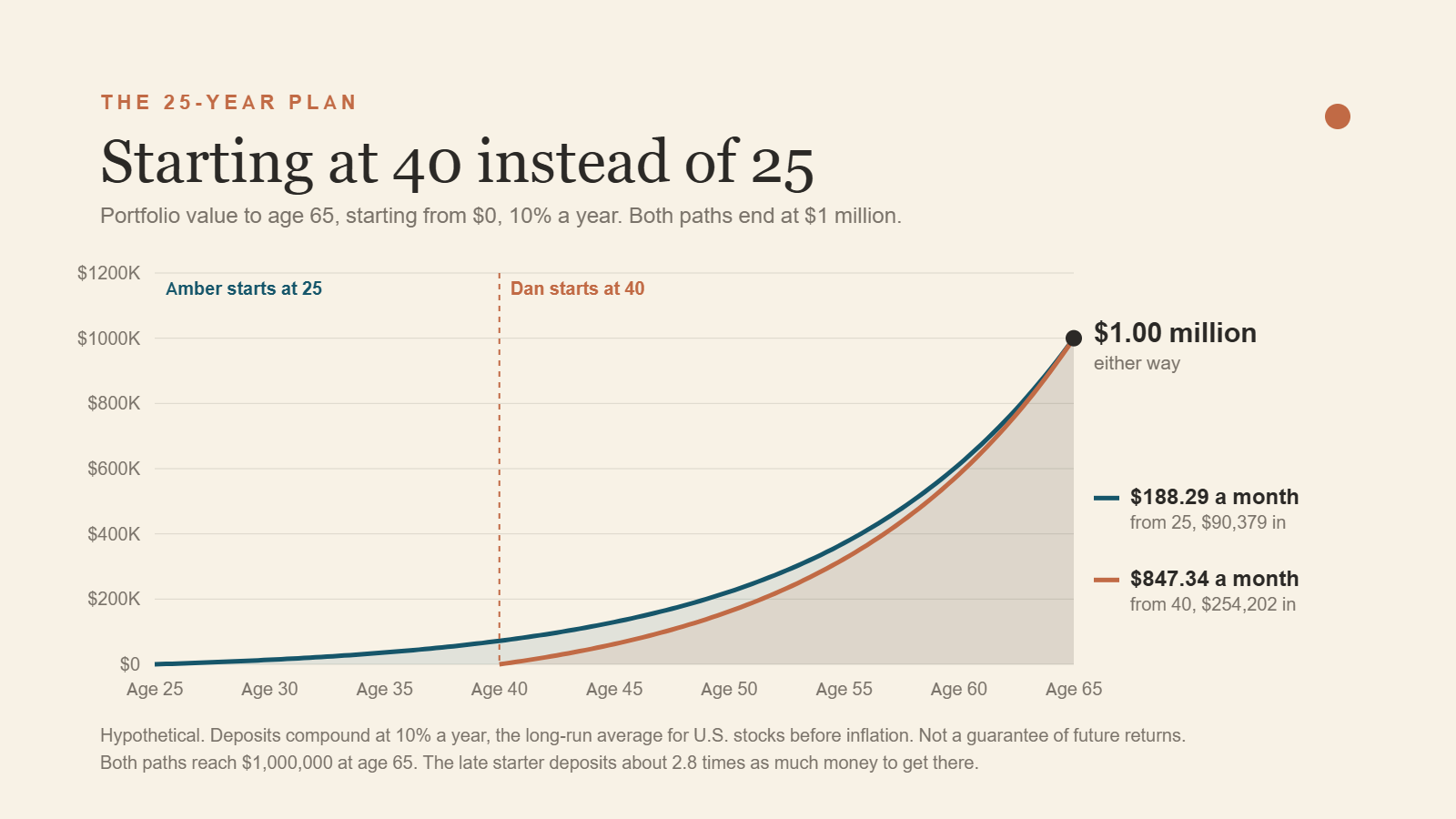
The point isn't that Dan is behind. It's that the monthly number climbs every year you wait, so the best time to start investing is whenever you're reading this.
Common questions
How much do I need to invest each month to have $1 million at 65? Starting at 25 with $0, about $188.29 a month gets you to $1 million by 65 if your investments average 10% a year, which is roughly the long-run average return of U.S. stocks before inflation. Starting later or earning less means a higher monthly number.
Is a 10% return realistic? It is the approximate long-run average for the U.S. stock market before inflation. After roughly 3% inflation, the average is closer to 7%. Individual years swing far above and below the average, so the figure only shows up for investors who stay invested through the down years.
How much income does $2.7 million provide in retirement? Under the 4% rule of thumb, about $106,000 in the first year, adjusted upward for inflation each year after. The research behind that rule assumes a balanced portfolio of stocks and bonds, so an all-stock portfolio would need to shift more conservative as retirement approaches.
Want to see your own number?
Bring your age, what you've saved so far, and what you can put away each month. We'll run the figures together and talk through where to put the money. Twenty minutes, no pressure.
Book a conversation