Corning's benefits package includes something rare: the Investment Plan 401(k) accepts after-tax contributions and lets you convert them to Roth inside the plan. Put those two features together and you get the mega backdoor Roth, a fully legal way to move tens of thousands of dollars a year into Roth savings. If you'd rather see the whole benefits picture first, start with our guide for Corning employees.
The three buckets inside your 401(k)
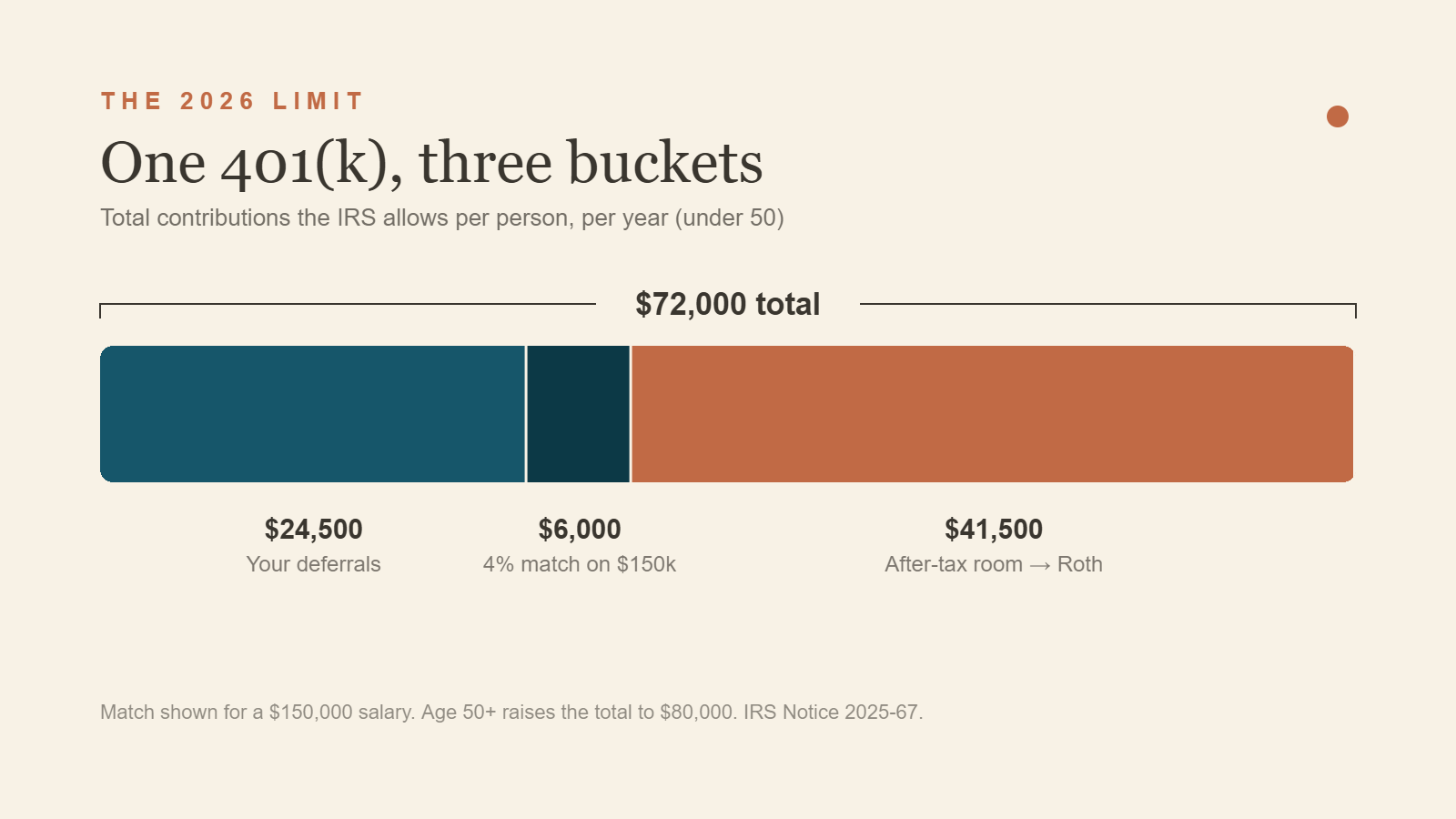
The IRS caps 401(k) savings twice. Your own paycheck deferrals (pre-tax or Roth) are capped at $24,500 for 2026. But total contributions from all sources are capped much higher: $72,000 if you're under 50, and $80,000 with the age-50 catch-up. Between those two numbers sits the gap most savers never touch.
Say Maria is 45, earns $150,000, and maxes her deferrals at $24,500. Corning's 4% match adds another $6,000 during the year. That's $30,500 of her $72,000 total. The remaining $41,500 is her after-tax room, and every dollar of it can become Roth. She's paying tax on those dollars once, when she earns them, and never on decades of growth.
The five steps
- Capture the full match first. Employer match is an instant, guaranteed return. Nothing below this line happens until the match is maxed.
- Turn on after-tax contributions. In the plan portal, this is a separate contribution type from pre-tax and Roth. Set it as a percentage of pay, sized so your combined total stays under the annual cap.
- Set up the Roth conversion. Elect automatic in-plan conversion of after-tax dollars if the plan offers it. If conversion is manual, calendar it and convert right after each contribution lands.
- Watch the ceiling. Deferrals, employer money, and after-tax contributions all count against the $72,000. A bigger bonus or profit-sharing year shrinks the after-tax room, so check the running total mid-year.
- Keep the paperwork. Each conversion generates a 1099-R at tax time. Handled correctly, the taxable amount on it should be tiny. Hand it to your preparer and you're done.
Why speed is the whole game
After-tax dollars themselves convert tax-free; you already paid income tax on them. The only taxable piece is the growth earned between the contribution and the conversion. Convert same-week and that growth is pennies. Let after-tax money sit unconverted for years and you've built a tax bill for no reason. Automatic conversion makes this a non-issue, which is why step three is the one I check first when reviewing a Corning statement.
Common questions, answered plainly
Is this legal? Yes. After-tax contributions and in-plan conversions are both written into the tax code and into Corning's plan document. Corning put it in the plan document on purpose.
Doesn't my income disqualify me from Roth? No. Roth IRA contributions phase out at higher incomes, but after-tax 401(k) contributions have no income limit. That's the point of the strategy: it's the Roth route built for high earners.
Is this the backdoor Roth IRA I've read about? No. That one moves $7,500 a year through a traditional IRA and gets tangled by the pro-rata rule if you hold other IRA money. The mega version lives entirely inside the 401(k), the pro-rata IRA rule doesn't apply, and the dollar amounts are several times bigger.
Who should skip it? Anyone whose match isn't maxed, whose cash reserve is thin, or who's carrying expensive debt. This is a strategy for genuinely spare dollars. If filling the after-tax bucket means the vacation fund or the emergency fund goes hungry, skip it and revisit next year.
What if I leave Corning? Converted balances are Roth and stay Roth. At separation they roll cleanly to a Roth IRA and keep compounding tax-free. Leaving changes nothing about money already converted. And if you leave at 55 or later, the pre-tax side of the plan may be reachable early too; see where the doors are before 59½.
The bottom line
A boring paycheck deduction, converted on autopilot. For a mid-career Corning employee with surplus cash flow, I think it's the single most valuable line in the benefits package. Ten years of $40,000 contributions is $400,000 of principal growing tax-free, before a penny of growth.
The rest of the Corning picture, including the pension election and SIP deferred comp, lives in our guide for Corning Incorporated employees.
Want the after-tax percentage sized to your actual paycheck?
Bring a recent pay stub and your latest plan statement. We'll set the contribution rate, check the conversion election, and make sure the ceiling holds. Twenty minutes, no pressure.
Book a conversation