Ask most people what they pay their financial advisor and you'll get one of two answers: "I'm not sure" or "I don't think I pay anything."
Both answers are the industry working as designed. Fees get split across an advisory charge here, a fund expense ratio there, maybe a commission baked into a product you were "recommended" — none of it arriving as a bill you'd ever see. You can't shop what you can't find.
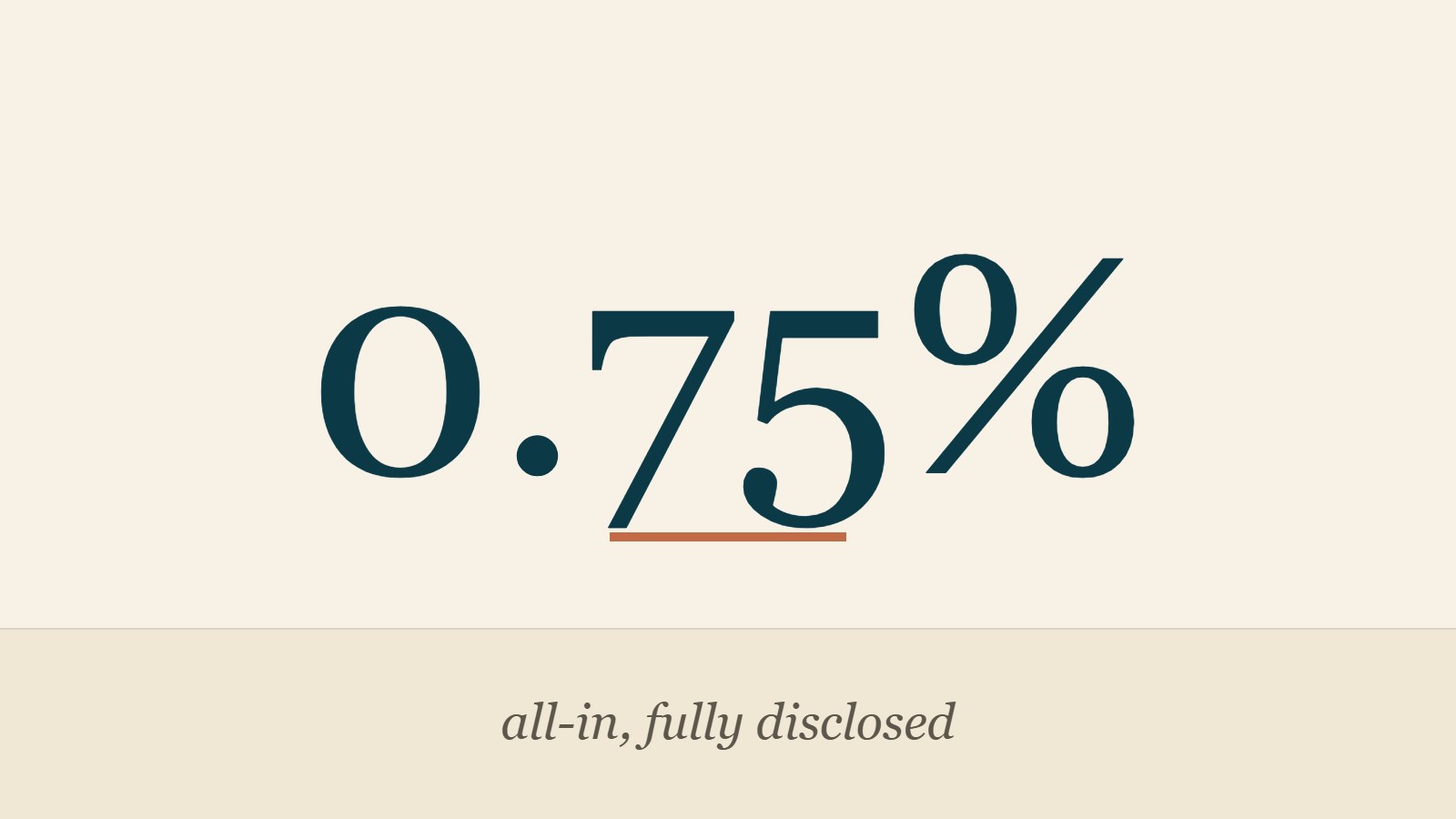
So let me do the thing our industry hates and put ours in writing: clients here pay one flat advisory fee — 0.85% of assets per year to start, dropping automatically to 0.80% at your 2-year anniversary and 0.75% at your 5-year. No commissions. No minimums. No products. That's the whole fee page.
First, the math in dollars
Percentages hide things, so let's use dollars. On a $500,000 portfolio, 0.75% is $3,750 a year — about $312 a month. On $1 million, it's $7,500 a year.
Is that a lot? It's certainly not nothing, and anyone who tells you their fee "doesn't really matter" is selling something. The honest question isn't "is it a lot" — it's "what do I get for it, and what would I pay elsewhere?"
What the typical arrangement actually costs
The common setup in this industry stacks three layers:
- An advisory fee, commonly around 1% per year.
- Fund expenses — the mutual funds and ETFs your advisor puts you in charge their own internal fees, often several tenths of a percent, quietly netted out of returns.
- Product costs — commissions and trails on insurance and annuity products, when the "advisor" is also a salesperson.
Stack the first two and plenty of well-meaning people are paying 1.4% or more without ever writing a check. On that same $500,000, that's $7,000+ a year — for something they'd describe as "I don't think I pay anything."
What our fee covers
One fee, everything included:
- The plan. A real financial plan — retirement and income, taxes, education, insurance gaps, estate basics — built around your actual life, revisited all year, not a PDF that dies in a drawer.
- The portfolio. We invest mostly in individual companies you can name and understand, held directly in your account. Owning businesses directly means there's no layer of fund expense ratios stacked on top of our fee.
- Year-round tax thinking. Asset location, loss harvesting when markets hand us the chance, Roth conversion math, coordinating with your CPA before decisions instead of after.
- The talking-off-the-ledge service. Candidly, this is where an advisor earns the fee. The plan only works if you stay in your seat during the 2022s and the 2020s of the world. When the market drops 25% and every headline says it's different this time, you have someone to call whose incentives point the same direction as yours.
What it will never buy you
A crystal ball. I don't know what the market will do next year, and neither does anyone else you could hire. If an advisor's pitch is beating the market, you're paying for lottery tickets. Ours is simpler: keep more of what the market gives, pay less in taxes and fees along the way, and don't blow up the plan at the worst possible moment. That's the compounding that's actually within anyone's control.
Why the fee falls instead of rises
Most fee schedules in this business fall for exactly one reason: your account got bigger. Ours does that too — 0.75% past $1 million, 0.65% past $2 million, 0.45% past $5 million. The part almost nobody else does is time: your fee also drops to 0.80% at your 2-year anniversary and 0.75% at your 5-year, and you always pay whichever rate is lower. The logic is simple: the longer you stay, the more your trust is worth to this practice, and the fee should say so.
If you're not sure what you're paying today, that's worth twenty minutes of your time. Bring a statement. We'll find the fees together — all of them — and you can decide from there. No pressure, no pitch.
Want to know what you're actually paying?
Bring a statement — we'll find the fees together. A relaxed, 20-minute conversation, no pressure.
Book a conversation